

- Google doesn’t hate AI, it hates bad content
- What AI can actually do well
- And where does it fail? In almost everything that matters—if you don’t know what you’re doing.
- Tools that can help you apply AI in SEO
- AI is not strategy. It’s speed. And without direction, speed takes you straight to the edge
- At Tuatara, we use AI, but the right way
Everyone’s talking about AI in SEO. Many are jumping on the bandwagon, but only a few are actually doing it right. The rest are just churning out “whatever the tool says,” hoping Google will gift them traffic for stuffing 800 words with awkward keywords. Spoiler alert: that’s not going to happen.
AI won’t fix your SEO if your strategy already ghosted the call. It won’t make you go viral. It won’t boost your rankings if the content you’re publishing doesn’t matter to anyone.
But let’s break it down. Because yes, AI has potential—a lot. But if you’re using it just to “crank out blog posts fast,” we’ve got bad news: that’s not a strategy. Let us tell you why!
Google doesn’t hate AI, it hates bad content
First things first: let’s stop repeating myths. Google doesn’t penalize content just because it was created with AI. It penalizes content that’s useless. If your blog post screams “I wrote this in 2 minutes with a generic prompt,” it’s not the algorithm punishing you—it’s your lack of effort.
Since the Helpful Content update, Google rewards usefulness, clarity, and well-executed intent. Not the source of the text. So yes, you can use AI—but if you don’t edit it, adapt it, and connect it to a clearly defined strategy, you’re basically publishing air in HTML format.
What AI can actually do well
AI isn’t a star copywriter. It’s more like that energetic intern—eager to help, good intentions, but lacking the judgment to get it right on their own. If you give it clear instructions, it’ll support you. But leave it on its own, and it won’t give you the help you really need.
Research keywords without losing your mind
AI—especially tools like ChatGPT combined with extensions like Keywords Everywhere, or platforms like AlsoAsked or Answer the Public—can be your best ally in the most tedious part of SEO: finding content ideas that actually connect with your audience’s search intent.
A realistic example? Let’s say you’re trying to rank a marketing automation tool that includes CRM, automated email flows, and lead scoring. You could prompt the AI like this:
“Give me 15 long-tail content ideas based on ‘marketing automation’ for a Colombian blog, mixing informational and commercial intent”.
And boom, you get results like:
- “How to automate email campaigns without sounding robotic”
- “Benefits of integrating your CRM with automation tools”
- “Common mistakes when building lead nurturing workflows”
- “Marketing automation for small teams: where to start?”
- “Recommended marketing automation tools for SMEs in Colombia”
Are all of them useful? Not necessarily. But it cuts your brainstorming time in half and gives you a clear direction to shape your content.
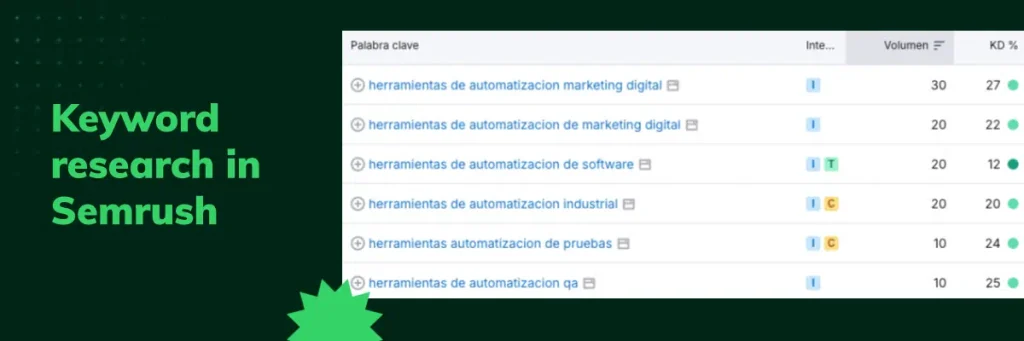
Now, should you trust that list blindly? Absolutely not. You still need to validate volume, intent, and competitiveness using tools like Semrush, Ubersuggest, or Ahrefs. But at least now you’re not starting from scratch.
Optimizing old content
If you’ve been publishing for more than a couple of years, chances are you’ve got blog posts that once performed well but are now buried on page 4 of Google. Not because they lack value—but because SEO evolves, search behaviors shift, and your competitors don’t sleep.
This is where AI can become a powerful ally. Tools like Surfer SEO, NeuronWriter, or MarketMuse use natural language processing and real-time SERP analysis to compare your content with what’s currently ranking. With them, you can identify:
- Which relevant keywords are missing
- What structure top-ranking content is using
- What semantic entities and terms you should mention more often
- Which related topics you could cover to add depth
These tools use models like BERT (from Google) or GPT (from OpenAI) to detect content gaps and suggest optimizations that add not just text—but context and relevance. It’s not about padding articles with extra paragraphs, but about improving user experience and aligning with search intent, which is exactly what Google’s Helpful Content update prioritizes.
Do you need to rewrite from scratch? Not necessarily. But you do need a critical review—with AI as your copilot—to decide what to update, cut, or expand. This approach can breathe new life into old posts, bringing back visibility and boosting key metrics like CTR, time on page, and conversion rate.
That said, don’t fall into the “just add these keywords and call it a day” trap. AI can tell you what to include, but the how and why are still 100% human. That’s the difference between updating and over-optimizing.
You might be interested in: Uses and trends of artificial intelligence in digital marketing
Speeding up repetitive tasks without sacrificing quality
Another major advantage of AI lies in the day-to-day content grind: those repetitive tasks that shouldn’t drain your creative time—but somehow do. We’re talking about:
- Generating title variations for A/B testing
- Writing meta descriptions that don’t sound like recycled ads
- Testing different introductions to better hook the reader
- Repurposing content for different formats or platforms (e.g., turning a blog post into a LinkedIn or Instagram post)
Need to rework a headline to make it more clickable? Instead of spending 30 minutes chasing “the perfect phrase,” you can ask AI:
“Give me 5 more creative, short, click-oriented versions of the title: How to improve your online store’s SEO.”
And you might get suggestions like:
- “Take your ecommerce store to the top of Google”
- “SEO that sells: your online shop needs this”
- “Rank or tank: the SEO your ecommerce can’t ignore”
Are they perfect? No. Are they useful for sparking ideas and speeding up decision-making? Absolutely. AI doesn’t replace your judgment—but it helps you produce faster and with less friction. And in a digital world where teams need to execute without dropping quality, that’s a game-changer.
And where does it fail? In almost everything that matters—if you don’t know what you’re doing.
AI doesn’t know your audience is Colombian. It doesn’t realize your top competitor is a local SEO giant. It has no clue the keyword you’re obsessed with has zero commercial intent.
- It doesn’t understand cultural context: It writes like a boring encyclopedia. If you don’t fix it, your blog will sound like a university PDF from the U.S. circa 2004.
- It doesn’t write for humans: Its tone is flat, generic, and often feels like “I’ve read this before.” Because chances are, you have.
- It has no strategy: It can throw ideas at you, but it doesn’t know if they align with your business goals, your funnel, or your KPIs. That part? That’s on you—or someone who knows what they’re doing.
Tools that can help you apply AI in SEO
Let’s name names—because that’s what you’re here for:
- Semrush (with LLM visibility):
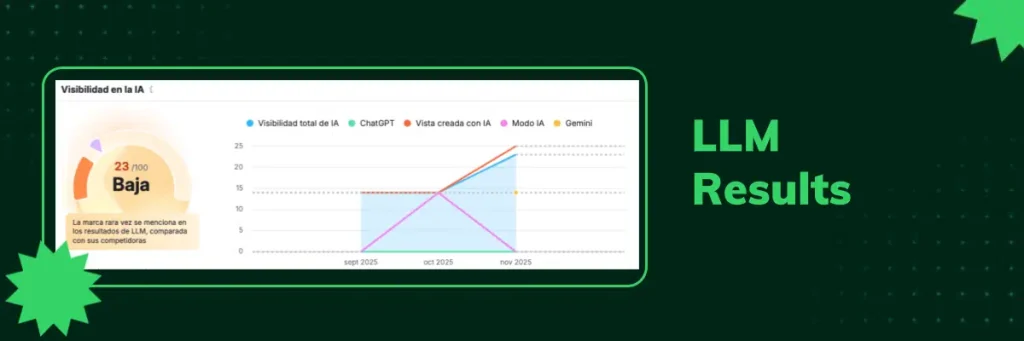
Beyond keyword research, Semrush now lets you analyze if your brand shows up in language model results (LLMs) like ChatGPT and Gemini. This is a new and crucial KPI: if you’re not appearing in AI-generated answers, you’re losing brand visibility to your competitors. At Tuatara, we include this in our strategic reporting. - ChatGPT + AIPRM / Keywords Everywhere:
A useful combo for quick research. It provides long-tail ideas, content structures, and preliminary search volumes. Great for getting started and giving your content a clear direction. - Surfer SEO:
Analyzes your content against top-ranking pages in Google. It tells you what terms to include, how to better structure your post, and what to improve to compete smarter in the SERPs. - Frase.io:
Clusters topics, organizes data, and suggests content pathways aligned with search intent. Works well as an editorial guide, especially when you need to break out of the same old content angles. - NeuronWriter:
Focused on technical analysis and semantic depth. Perfect for specialized industries where precision in language and alignment with modern algorithms (like BERT or GPT) matter more. - Jasper:
Generates quick commercial copy for ads, headlines, or product descriptions. It’s powerful, but the output tends to be generic—so you’ll need to edit if you want to keep your brand’s unique tone. - Gemini (Google’s AI):
Google’s language model is being integrated into its ecosystem. Its impact on search and AI-driven answers will only grow. Monitoring how it responds to topics related to your brand will be key for future conversational SEO strategies.
You might also be interested in: MOZ, SEMrush or Ahrefs — Who’s really telling the truth about your domain authority?
AI is not strategy. It’s speed. And without direction, speed takes you straight to the edge
AI in SEO has unlocked huge possibilities—faster content creation, mass production, headline tweaks, idea generation, and multi-format adaptation. But that alone doesn’t mean growth. In fact, it can be the opposite. Publishing for the sake of publishing, with no logic behind it, is just a more sophisticated way of wasting time.
Organic positioning is still a long game. It requires understanding how your audience behaves, what they need, where they are in the decision journey, and how each piece of content fits into your site’s ecosystem. If that’s not clear, what you’re doing with AI isn’t SEO—it’s empty automation.
Yes, AI can help you draft faster, generate outlines, and even suggest optimizations. But it can’t give you business insight. It can’t prioritize content that makes sense for your funnel. It can’t design how your content connects and flows. It gives you speed—but not direction.
That’s why many brands are building a content house of cards with AI. All it takes is a single Google update for it to collapse. Why? Because there’s no solid foundation. No editorial logic. No clear path guiding users beyond the first click.
Even today, SEO is still technical and strategic work. It requires thinking about site architecture, search intent, internal linking, content usefulness, and user experience.
At Tuatara, we use AI, but the right way
Yes, we integrate AI into our workflow. But we don’t let it loose like it’s an expert in Colombian digital marketing, complex buyer personas, or content architecture.
We use it to move faster, sure. But we edit, think, compare, analyze. Because experience can’t be improvised. Strategy can’t be automated. And digital authority can’t be copied and pasted.
Got a stack of AI-generated drafts and not sure whether to publish them? Don’t—until someone with real expertise reviews them. Want your content to scale without sounding like the same 100 blogs your competitors already published? That takes structure, strategy, and a touch of irreverence.