

- GEO Is Not Just SEO With a New Name
- The Numbers No One Wants to Look At
- What a GEO Strategy Really Aims For
- Phase 1: Seeing Your Content with New Eyes
- Phase 2: Creating Content Designed for Conversations
- Phase 3: The Technical Side Speaks Too
- Phase 4: Authority Beyond Your Domain
- Phase 5: Measuring What Wasn’t Measured Before
- Who Should Lead This?
- The Real Differentiator in 2026
- GEO is not the future — it’s the present (and we’re building it with you)
Your team is reviewing the monthly report. Organic traffic is dropping. Not just a little — it’s really dropping. No one touched technical SEO. No one deleted key content. Rankings are still there. Then someone says the uncomfortable truth: “People just aren’t clicking anymore.” And no, it’s not a perception. It’s the new standard.
That’s when a word comes up — one that still feels unfamiliar in many work meetings: GEO. Not as a trend, but as an explanation. Because the issue isn’t just about ranking first on Google anymore. The issue is that now, the answer shows up before you do. And often, without you.
Search has changed. In 2026, users don’t browse — they ask. And AI engines respond, summarize, recommend, and cite. That’s where real visibility is decided today.
GEO Is Not Just SEO With a New Name
Let’s get something straight: GEO doesn’t replace SEO — it puts it against the wall.
For years, SEO was the official language of digital visibility. Rankings, keywords, backlinks, traffic. Everything revolved around showing up first and driving users to the site. And it worked. The problem isn’t that it stopped working — it’s that it’s no longer enough.
Today, you can rank high and still be absent from the conversation. Because the answer no longer lives in your blog — it lives in a summary. And that summary is generated by AI.
GEO (Generative Engine Optimization) was born right there. Not to fight against SEO, but to cover what SEO was never built to do: make your content understood, selected, and cited by generative engines.
The difference is subtle — but brutal:
- SEO competes for position.
- GEO competes for interpretation.
And once you understand that, it changes how you write, structure, and decide what’s worth publishing.
The Numbers No One Wants to Look At
Some data is uncomfortable because it forces us to rethink everything. This is one of those cases.
Nearly 60% of searches now end without a click. Not because the content is bad, and not because Google is penalizing anyone — but because AI answers first. It summarizes. Synthesizes. Delivers an instant solution.
At the same time, digital media outlets have reported up to a 33% drop in yearly organic traffic. Not due to technical errors or penalties, but because user behavior has evolved faster than most strategies.
Measuring success solely by visits is like judging a brand by how many people enter the store, while ignoring those who just ask from the window. Today, visibility happens even without direct interaction.
That’s why the right question is no longer “What’s my ranking?” — it’s “Is my content clear, trustworthy, and well-structured enough for an AI to use it without distorting it?”
That’s where a GEO strategy stops being optional.
What a GEO Strategy Really Aims For
A GEO strategy doesn’t try to trick AI or force results. It does something much simpler — and much harder: it makes the AI’s job easier.
AIs don’t improvise from scratch. They rely on sources, select content they can quickly understand, summarize without losing meaning, and that conveys authority without exaggeration.
That’s why your content should:
- Answer real questions, not brand assumptions
- Follow a logical structure that can be broken down and reassembled
- Use natural language, not unnecessary jargon
- Show expertise without self-proclaiming as an expert
When that happens, AI doesn’t fill in gaps — it quotes. And when it quotes, your brand stays visible even when clicks are no longer the center of the equation.
You might also like: Discover the latest updates to Google’s AI and strengthen your SEO strategy
Phase 1: Seeing Your Content with New Eyes
The first mistake when thinking about GEO is assuming everything starts from scratch. A GEO audit begins with a simple idea: not all content works, but a lot of it could work better. It’s about identifying which pieces already carry informative intent, semantic depth, and a clear question behind them.
In this stage, the longest text or the one most optimized for keywords doesn’t win — the one that explains best does.
This phase involves reviewing introductions that say nothing, bloated paragraphs, and headings that overpromise and underdeliver. The content is reorganized so AI can understand each section effortlessly.
Lists, definitions, FAQs, cited sources, real examples — everything counts when it reduces ambiguity. This is the moment when content stops being written to rank, and starts being written to answer.
Phase 2: Creating Content Designed for Conversations
GEO content isn’t written like a traditional article. It’s built like a well-guided conversation.
It starts with long-tail questions — real doubts phrased exactly how people think them. Not forced keywords or inflated headlines.
The tone is human, direct, and clear. Each section serves a specific purpose. Each paragraph answers something concrete.
That’s GEO marketing: understanding that you’re no longer just speaking to a reader — you’re speaking to a system that decides whether your content deserves to be used as an answer.
In-depth guides, honest comparisons, clearly outlined step-by-steps, mini FAQs that anticipate objections. Not for the sake of format, but because they make understanding easier.
When your content can be read aloud and still make perfect sense, it’s ready for GEO.
Phase 3: The Technical Side Speaks Too
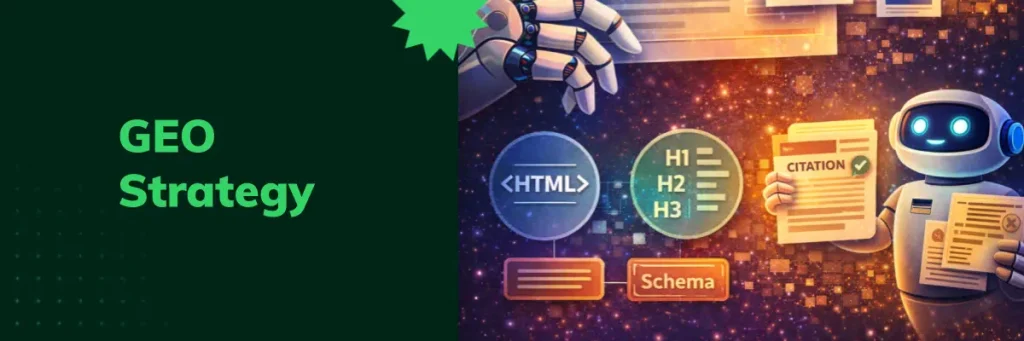
AI reads structure, context, and order. A slow site, with poorly structured headings or blocked content, is hard to interpret. And what’s hard to interpret gets ignored.
This is where often-overlooked factors come in: clean HTML, clear heading hierarchy, readable URLs, consistent load speed.
Schema markup, accessibility, proper rendering — none of this is glamorous. But all of it determines whether your content can be processed without friction.
Technical optimization stops being a checklist and becomes a basic condition for existing in generative environments.
Phase 4: Authority Beyond Your Domain
This is where many strategies fall short. AIs don’t just trust what you say about yourself — they trust what others say about you. Media outlets, niche platforms, public profiles, contextual mentions.
An SEO agency that understands this reality doesn’t chase backlinks for volume or artificial rankings. It seeks genuine presence in spaces where conversation and credibility already exist.
That external visibility builds an authority that doesn’t rely on a single metric or the next algorithm update.
Phase 5: Measuring What Wasn’t Measured Before
GEO isn’t validated by passively waiting for results. It’s tested actively. Regular prompts in ChatGPT, Gemini, or Perplexity help determine if the strategy is working. Does your brand show up? Are you being cited? Used as a reference?
If you don’t show up, it’s not failure — it’s insight. You adjust structure, reinforce sources, clarify answers.
If you do show up, you analyze why. What format worked. What approach was clearer. What’s worth repeating.
Continuous improvement stops being reactive and becomes strategic learning.
Who Should Lead This?
Not every agency is ready for this shift. GEO requires content, technical expertise, analysis, and reputation working together — not in silos. Not measured by deliverables, but by impact.
That’s the approach Tuatara Boutique Agency takes: treating GEO strategy for what it truly is — the natural evolution of SEO in an AI-dominated landscape. It’s not about producing more; it’s about building assets that remain visible when clicks stop being the core metric.
You might also like: Everyone is using AI in SEO and nobody has any idea what they’re doing
The Real Differentiator in 2026
Brands that understand GEO early won’t just “recover traffic” — they’ll change how they are discovered. Because when your content is cited, you’re not competing for attention. You already have it. And in a world of instant answers, that’s the biggest advantage of all.
GEO is not the future — it’s the present (and we’re building it with you)
A GEO strategy isn’t just a reaction to how search has changed. It’s a necessary evolution to remain relevant when clicks are no longer in control.
At Tuatara Boutique Agency, we design GEO strategies that don’t compete with generative engines — they turn them into allies. Because we understand that today, visibility means being useful, clear, and authoritative.
Our approach goes beyond traditional SEO: we connect content, technical precision, and reputation so your brand doesn’t just appear in search results — it gets cited as a trusted source in AI-led environments. That’s how we build future-ready visibility: through mutualism, certified processes, expert teams, and measurable results at every stage.
Ready to build your GEO strategy with us?