
- A Culture Built with Mutual Intent
- A Tool Aligned with Our Way of Thinking
- Recognition as a Daily Practice
- Solid Culture, Sustainable Results
- Cultural Infrastructure for Remote-First Teams
- Culture and Digital Strategy Growing in the Same Direction
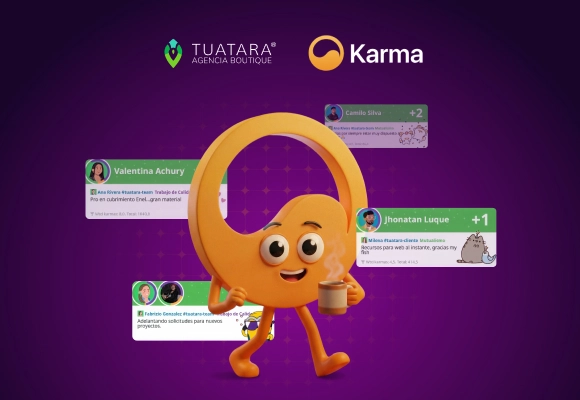
Karma is part of Tuatara’s cultural ecosystem. More than just a tool integrated into Slack, it has become a system that enhances something that has always been essential to us: recognition as a driver of growth and cohesion in remote teams.
At Tuatara Boutique Agency, we have spent over 10 years building digital ecosystems for multinational companies, integrating strategy, branding, marketing, sales, and software development under a clear vision: digital transformation only works when it operates as a coherent system.
We operate as a remote-first agency, with ISO 9001–certified processes and methodologies that ensure operational clarity and real-time measurement. On this solid foundation, we decided to further strengthen our culture, understanding that sustainable growth depends as much on people as it does on strategy.
Our CEO, Fabrizio González, expresses this clearly when speaking about remote work: “One of the greatest challenges in this digital way of working is how to keep culture alive when each person is at home.” This reflection does not come from concern, but from intention. If the environment changes, culture must evolve as well — and that evolution requires design.
A Culture Built with Mutual Intent
The remote model expanded our possibilities: diverse talent, intelligent flexibility, and teams connected from different cities and countries. At the same time, we designed mechanisms to strengthen daily connections between people, understanding that culture lives in small, everyday gestures: timely recognition, visibility of effort, and public validation of work well done.
For us, culture is not an institutional statement; it is a constant practice. We operate under the concept of Business Mutualism, which implies transparent relationships, shared growth, and collective responsibility. This philosophy shapes both our client relationships and our internal dynamics. If we promote collaboration, we recognize it; if we seek excellence, we celebrate it; if we drive collective growth, we make individual contributions visible.
Within this context, Karma was naturally integrated into our daily operations.
A Tool Aligned with Our Way of Thinking
Slack is the center of our internal communication, so integrating Karma into that environment allowed recognition to happen seamlessly and naturally. As a boutique agency, we understand that experience matters — and that brand coherence reflects a company’s intent.
Fabrizio summarizes it this way: “I understood that companies live as long as their brand makes an impact, and that’s something Karma does very well.” This alignment between design, clarity, and purpose made adoption within the team easy. The tool does not impose a rigid process; it enables a practice that was already present in our culture and makes it visible every day.
Recognition as a Daily Practice
Over time, recognition stopped being an isolated event and became part of the team’s natural rhythm. To date, we have issued more than 25,000 recognition points among collaborators. More than just a number, it represents consistency and frequency.
Recognition flows horizontally across areas and roles. Designers recognize developers, marketing recognizes sales, strategy recognizes execution. This dynamic strengthens trust and elevates collaboration, because each person understands that their contribution is visible and valued within the system.
Fabrizio describes it simply: “We are a company of humans for humans, with a transparent approach, where we acknowledge our limitations and also celebrate the achievements of others.” That philosophy turns recognition into a natural expression of the way we work.
Watch the full interview here.
Solid Culture, Sustainable Results
In digital environments, processes and technology drive efficiency. Culture drives sustainability. When people feel valued, they work with greater commitment; when they feel part of a coherent system, they take responsibility with greater intention.
In 2023, we achieved an NPS of 97%, with 98% overall satisfaction and 100% client recommendation. These results reflect strategy and processes — but also culture. Recognition strengthens the quality of work, and the quality of work strengthens results.
Digital transformation is not only about tools, automation, or custom software. It is about integrating technology and people. As we often say internally, technology enables performance; culture sustains it.
You may also be interested in: Vantage Case Study: Digital Strategy to Consolidate Its Expansion in LATAM
Cultural Infrastructure for Remote-First Teams
After six years of integrating Karma into our internal ecosystem, recognition has become part of our cultural infrastructure. Just as we invest in tools to optimize processes or measure KPIs, we invest in systems that strengthen human connection, because we understand that companies grow when their culture is coherent with their strategy.
We continue building digital ecosystems for companies across the United States, Latin America, and Europe — integrating strategy, impeccable design, software experiences, and data-driven marketing. We do so with a team that recognizes one another, validates contributions, and grows together.
Designing culture with intention is one of the greatest strategic differentiators for any remote-first company. At Tuatara, we live it every day, strengthening a culture where each person feels seen, valued, and connected.
Culture and Digital Strategy Growing in the Same Direction
Strengthening our culture with Karma was a decision aligned with how we understand business: any system that seeks to grow requires intention, design, and consistency. Culture works the same way as a digital strategy. When it is structured, measured, and integrated into daily operations, it becomes a real competitive advantage.
At Tuatara, we design digital ecosystems where strategy, technology, and people operate in sync. We apply that same systemic vision internally. Just as we plan a digital architecture for our clients, we structure a cultural architecture that fosters collaboration, trust, and constant recognition.
We believe in mutualism as an operating principle and in recognition as a daily practice that strengthens shared growth. Karma amplifies that dynamic and integrates it into our workflow, aligning culture with purpose — and purpose with results.
We continue evolving, incorporating new technologies, exploring artificial intelligence, and refining processes. At the center of that evolution are always people. Because when culture is coherent with strategy, growth stops being an isolated objective and becomes a natural consequence.
This is how we understand transformation: as a system where each part strengthens the other.